How working here has changed the way we shop
Kat KeenerOct 01, 2026
Where you work often impacts your habits and mindset. So when you work at Coupons.com, it’s pretty normal that your spending habits change for the better.
When do Black Friday sales begin? Are there more deals every year? Are they worth it? Do deals get better on Black Friday? We’ve reviewed five years of data to bring you definitive answers.
Black Friday deals arrive earlier and earlier. That’s what it feels like, anyway. And it’s why we decided to dig through our data to discover exactly when retailers launch their sales, when offers really start to pick up the pace, and whether early savings are as good as those on the day of Black Friday.
What we found wasn’t surprising, because we’re all right: Black Friday sales do start at the end of October. But our research found patterns that can help you know how to react to a weeks-long sales period. That way, you can confidently save during the Black Friday season.
To assess when Black Friday deals kick off, we looked at two forms of data:
The presence of the term “Black Friday” in all campaign communications made by our retailer partners over the last few years
Our own historical internal data to chart when Black Friday coupons went live and campaigns officially began
We reviewed every email relating to Black Friday that we received from 74 of the most popular retailers that we partner with during the last five years.
In doing so, we were able to determine recent trends for specific retailers. We paid special attention to:
Whether a retailer started its Black Friday offers before Black Friday itself. This is what we defined as “early” Black Friday sales.
If they did, when did they begin? Was it in late October/early November, mid-November, or late November?
Did the retailer increase its sales or offers on Black Friday, or did it stay the same as its pre-Black Friday deals?
While this entire dataset included retailers from all categories*, we also paid special attention to fashion and tech retailers since they’re two popular categories during Black Friday. We’ll use them as case studies throughout this article.
When we refer to communications made by our retail partners, some of this information is exclusive to our channels, derived from our long-standing relationships with these brands, while other communications are those any customer might receive through retailer newsletters, email updates, or targeted ads.
What sets our analysis apart is the extensive library of historical data we’ve built over time, which we’ve systematically recorded and analyzed to extract the key insights and trends.
Alongside this, we brought together every voucher that has been live on Coupons.com over the last five years that related to Black Friday.
This dataset is all our own in-house information that has been researched, vetted, and published by our savings experts over the years. Using it, we looked at how the Black Friday sales period has taken shape over the last five years. From this, we established patterns that show us what we can anticipate this Black Friday season.
A final thing to note is that we refer to any coupon, deal, code, exclusive code, or offer as a voucher. So, when we say “voucher” in this article, it is a collective, general term.
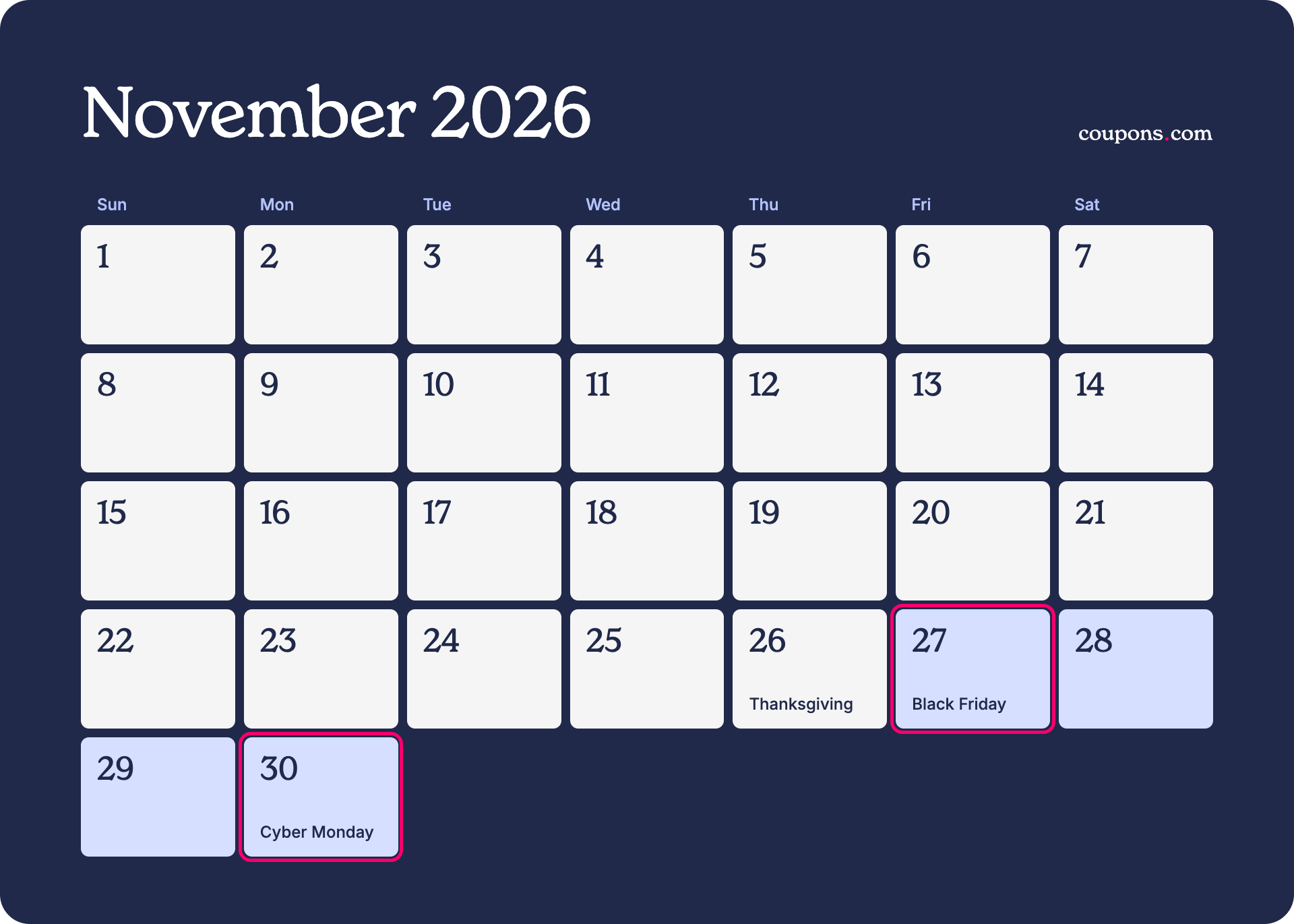
This year, Black Friday is on November 27th, 2026. Then, just three days later, Cyber Monday hits the scene on November 30th, 2026.
While some still hit department stores as soon as sales begin to get in-person deals, gone are the days of waiting in line for hours on Thanksgiving for Best Buy or Walmart to open at midnight. Nowadays, all you need is a good Wi-fi connection, paired with the knowledge of when the best time to buy is.
So let’s look back at the last five years to anticipate how this Black Friday season will take shape, and to find that “best time to buy”.
Our research found that 34% of retailers start their promotions as soon as the last week of October or the first week of November. In other words, campaigns kick off about a month before the actual day.
Since 2021, tech retailers have been particularly eager, with 47% of those that we analyzed starting sales during this time. That’s compared to just 28% of fashion retailers that launched their sales by the end of the first week of November.
Notable brands that are likely to be in the earliest cohort launching sales include Target, Shein, LG, Nomad, Wayfair, H&M, and The Children's Place.
After the initial launch of sales, Black Friday action really starts to pick up in mid-November. We found that 40% of the retailers begin their sales at this time. For 2026, that means that between November 8th and 21st, we expect to see the lion's share of retailers joining the sales.
So generally speaking, by the time we hit the week before Black Friday, nearly 75% of retailers that will participate in Black Friday are already participating.
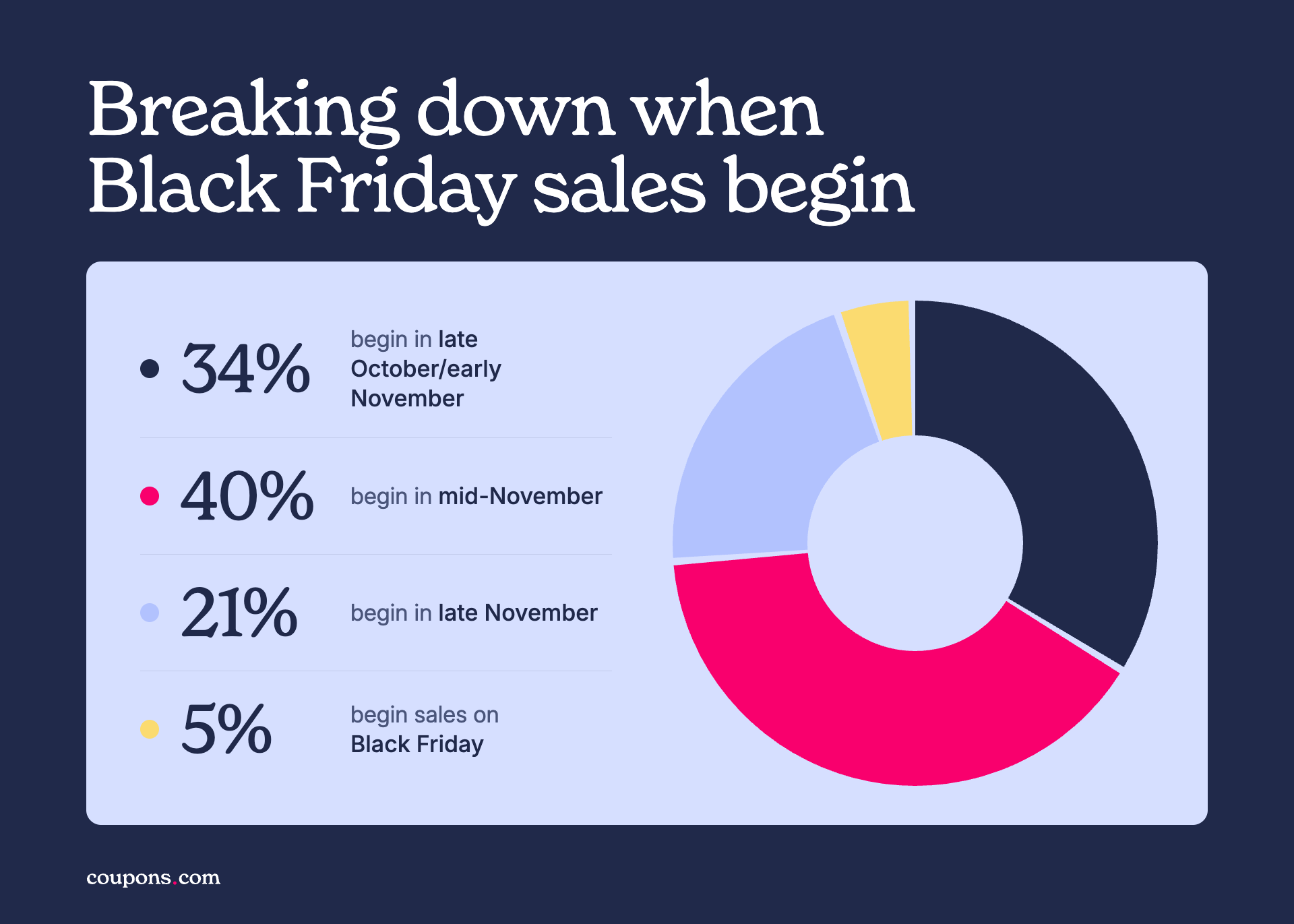
But there are still some retailers that don’t kick off sales until right before Black Friday. These retailers are, however, in the minority. In the years we analyzed, we found that just 21% of retailers wait until the last few days to begin their sales. This was particularly true of tech retailers, where only 7% launch deals in late November.
It’s not just more retailers taking part in Black Friday sooner, either. Our voucher data shows us two key aspects of Black Friday that could impact the way you approach the 2026 sales season:
Black Friday sales don’t really get started before Halloween.
Recent years have shown a pattern of more offers further ahead of Black Friday.
While it might not seem that profound that sales don’t really start before Halloween (we’ve seen the odd sale ahead of Halloween this year, but the number isn’t significant yet), it does impact the length of the sales period. Here’s how:
If Thanksgiving is late, the Black Friday season is longer.
If Thanksgiving is early, there are fewer weeks of savings.
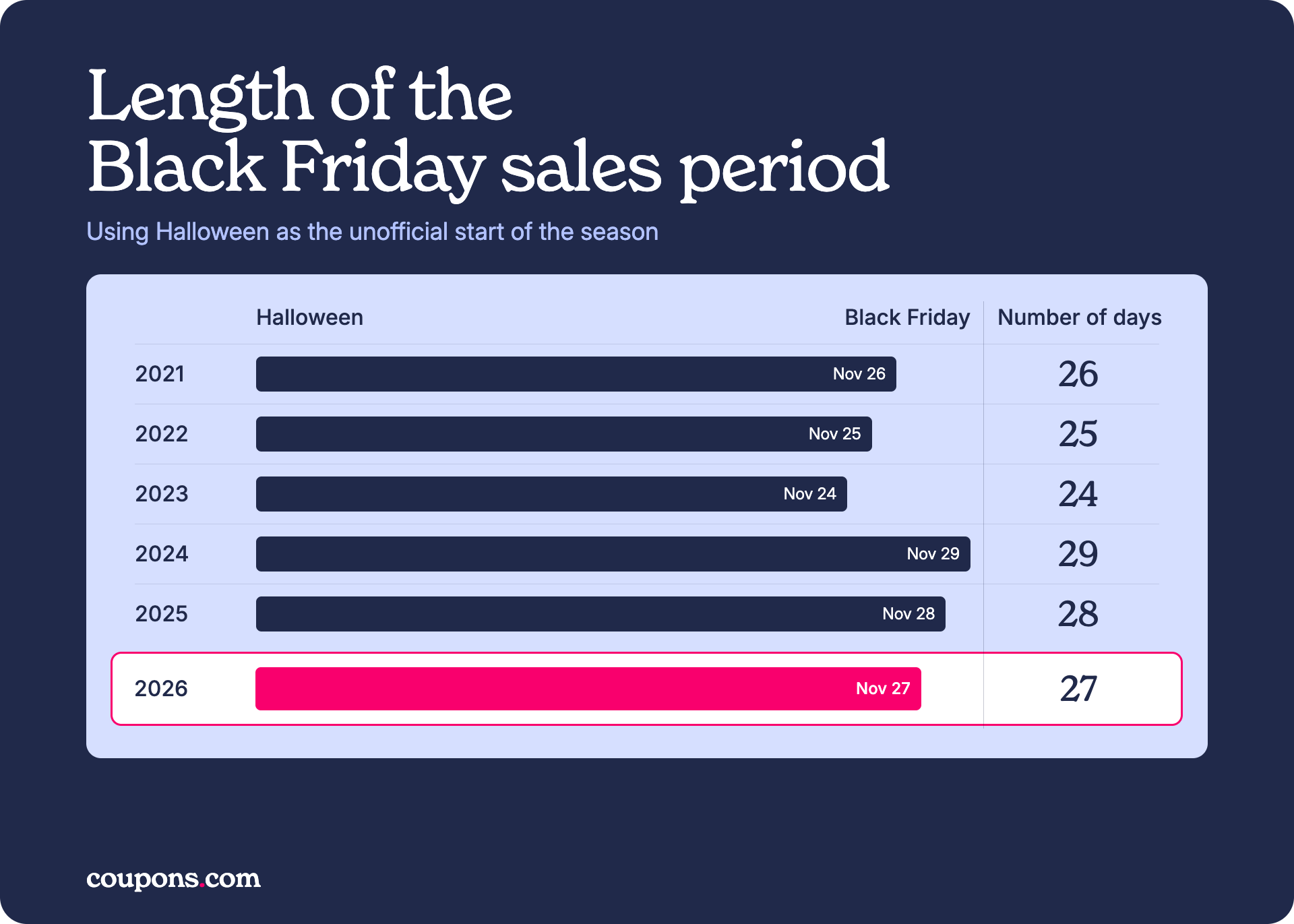
For example, in 2024, there were 29 days between Halloween and Black Friday compared to just 24 days in 2023. That means that in 2024, there was nearly an entire extra week of sales to be shopped.
At the maximum, there can be 29 days between Halloween and Black Friday and a minimum of 23. And currently, this pretty much dictates the length of Black Friday sales.
Of course, Black Friday sales often roll into Cyber Monday sales, which are sometimes extended into the week following Black Friday. Some retailers simply rebrand the same sale, while others offer bigger discounts for Cyber Monday, but not every retailer runs separate promotions.
According to our voucher history, Black Friday vouchers drop by as much as 45% during Cyber Monday week, and fewer than 7% remain by the following week.
Therefore, we view the weeks leading up to Black Friday as the main sales period. Any vouchers that are still active after Cyber Monday are unexpected bonuses.
This year, with Thanksgiving falling on the 26th, Black Friday will be relatively late. So, the sales season will last around 27 days.
The second, and possibly more exciting pattern our voucher history shows us is that in recent years, more offers are available further ahead of Black Friday than before.
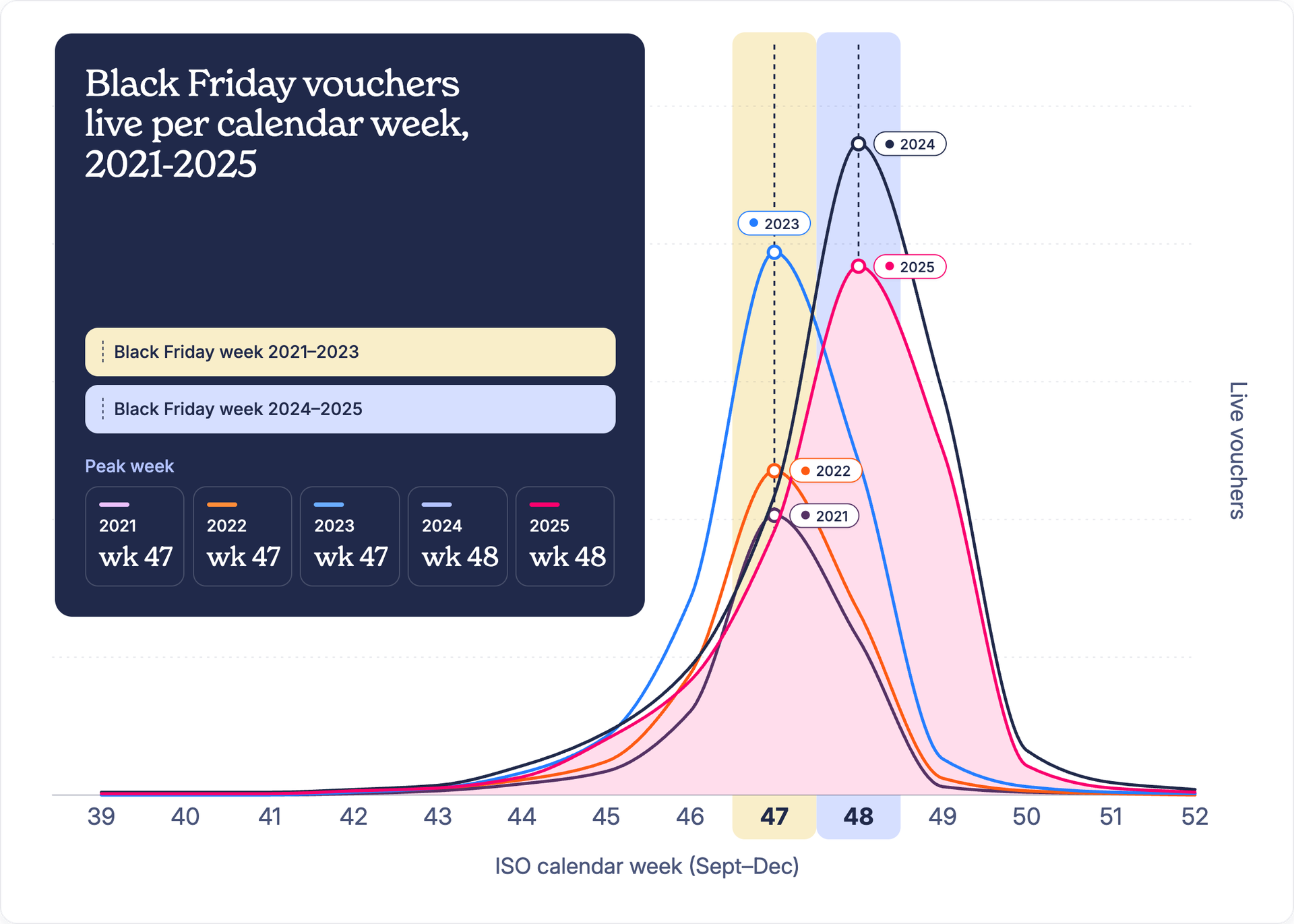
The number of Black Friday offers live always peaks right around Black Friday, as you would expect. But we’ve seen that there are more days with more vouchers. Let us explain.
If on Black Friday (or the day after Black Friday, like in 2023) we see 100% of Black Friday vouchers live, that's the peak number of vouchers for that year. In the days before Black Friday, we then see a percentage of those vouchers go live. The further ahead of Black Friday, the more time you have to shop those sales.
In 2023, live Black Friday vouchers hit 10% of the peak 18 days before Black Friday. They hit 25% eight days ahead and 50% just three days before the main event.
The next year (2024), 10% of that year's peak vouchers were live 24 days ahead of Black Friday, 25% was reached 10 days in advance, and 50% just four days before Black Friday.
Then, in 2025, we saw the longest periods for each percentage milestone. We saw 10% of vouchers live 23 days ahead of Black Friday, 25% of the peak were live 14 days before, and 50% seven days ahead of the official day.
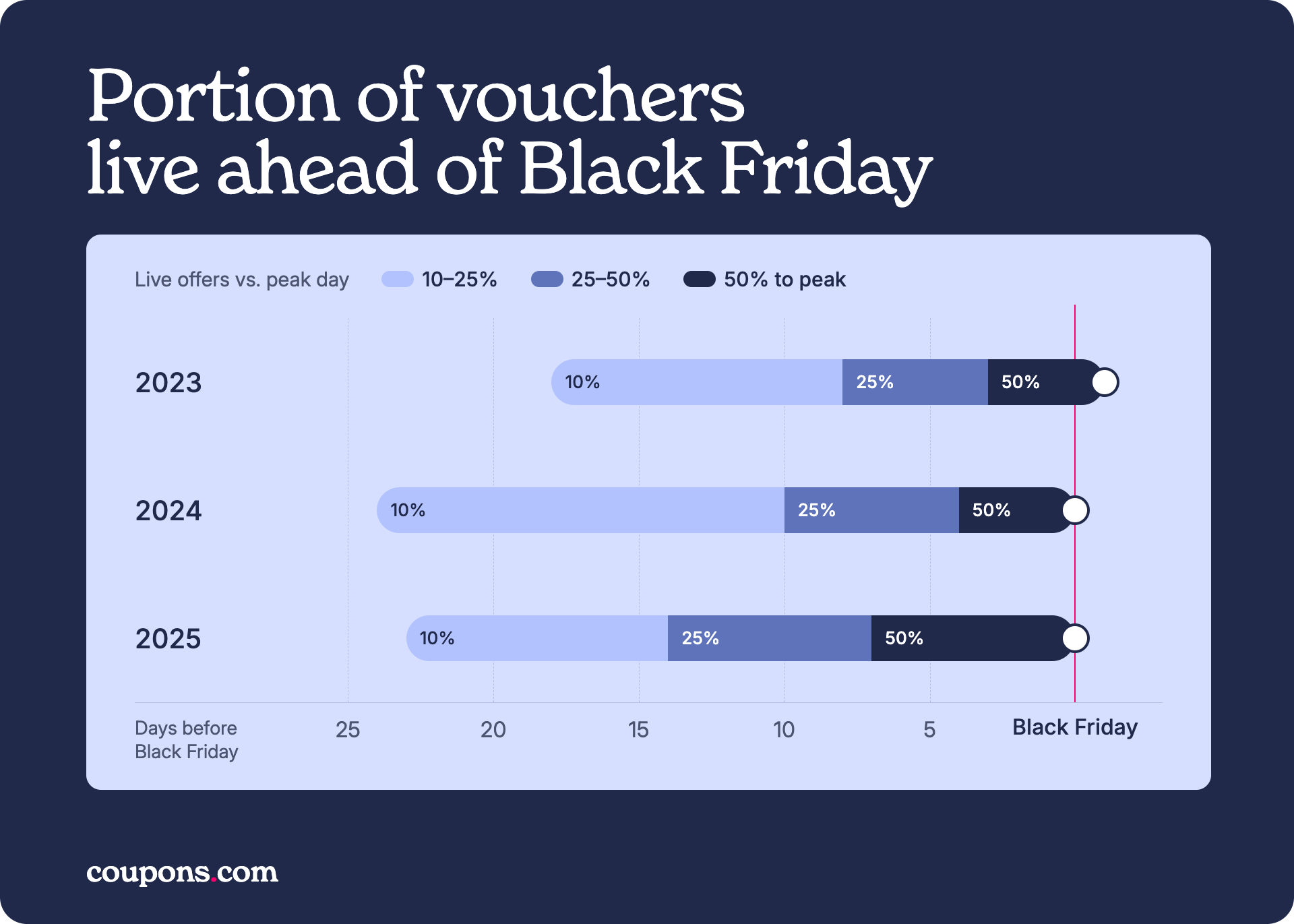
That means that the shape of the sales season has evolved, creating more time with more offers to use.
Since this pattern has only appeared in recent years, it’s daring to say that 2026 will continue in the same way. However, we do expect this year to at least keep to a similar cadence as 2024 and 2025, where more vouchers are live earlier in the sales period.
And while they’re few and far between, we’ve recently found, vetted, and published some pre-Black Friday offers, including:
SHEIN’s early Black Friday deal of up to 90% off.
A limited-time early Black Friday Mattress Firm coupon code for $700 off mattresses.
In gathering the data for our analysis, we noticed a few interesting, retailer-specific trends, too. There are some retailers that appear to rarely recreate their Black Friday plan of action. Then, there are those that have completely changed up their approach to the sales season.
These case studies are a good reminder that Black Friday trends are a good way to anticipate what’s to come, but it’s wise to be agile and expect that some things might change.
Here, we’ll explore these specific cases and cover a few reasons why a retailer might switch things up.
First, we had retailers that have very specific patterns for how they approach Black Friday. They were Bergdorf Goodman and Spanx, both of which, interestingly, wait until late November to start their sales.
Since 2022, Bergdorf Goodman has never started their sales more than three days in advance. During those same years, Spanx has also waited until the last few days before Black Friday to launch sales, but they’ve reserved their deals for members only.
Other retailers that keep Black Friday sales exclusive to members, like Levi’s, typically did so in the initial days of their pre-Black Friday promotions before opening them up to everyone. Spanx, however, hasn’t done that in recent history.
When we spotted this pattern, we can’t say that we were surprised by the retailers that tend to follow the same game plan each year. That’s because these retailers are those that simply run fewer sales throughout the year, so it would make sense that they don’t go all-in on Black Friday.
We confirmed this when analysing the number of vouchers the specific retailers we included in this study offered beyond Black Friday. Those that kick off Black Friday deals in late November, on average, ran 40% fewer discounts and coupons in 2025 than those that start their sales in early to mid-November. Likewise, they offered shoppers 33% fewer codes during 2025.
While these retailers have kept their Black Friday approach rigid, others really like to keep us on our toes by changing tactics each year.
Michael Kors, for one, used to launch their sale in late October, but in 2025, they pushed it all the way to late November instead. Samsung used to kick off their Black Friday sale in the first week of October, but over the last three years, they’ve shifted to either the last week of October or the first week of November.
Although they keep us guessing, it’s possible to infer why they’ve been less consistent. There are some big reasons why a retailer might do this, including:
A reaction to buyer’s fatigue, where shoppers get burnt out with ongoing, lengthy sales and simply choose not to buy.
Or, they may have seen that having a longer sales period doesn’t actually benefit them.
There are a number of reasons that a business could choose to change its Black Friday strategy, and it’s interesting to see it play out in data from the last five years.
Now that we’ve examined when Black Friday sales start, we’re taking it a bit further. Here’s what our research has shown us about how good pre-Black Friday sales are (or aren’t!).
Overall, no. While Black Friday was once a single day of major sales, the commercial period now stretches for weeks. And through our study, the data tells us that it’s rare for overall deals to get bigger and better on the day of Black Friday. That said, the answer isn’t as straightforward when you look at specific categories.
If you’re wondering instead if Black Friday is the day with the most deals, the answer is definitely. While nearly three out of four retailers have kicked off their sales before late November, there are still 21% of retailers that won’t start sales until the days before Black Friday and 5% that won’t launch sales until Black Friday itself.
Additionally, in the last few years, we’ve only reached 50% of our peak available Black Friday vouchers three to seven days before Black Friday. That means that before Black Friday week, half of the vouchers that were available in that year weren’t even live yet.
So, if you’re holding out for a retailer to cut prices on something you’re set on and they haven’t by mid-November, there’s still hope that they’re among those waiting until the last minute to treat shoppers to great prices.
When we looked more closely at specific categories, we found tech to be more similar to the rule while fashion retailers were occasionally more likely to break it.
When we considered tech only, less than a third of retailers had deals that got demonstrably bigger on Black Friday. A majority of tech retailers don’t run blanket, site-wide sales, either. Instead, their sales are tied to specific products or categories within tech. So, overall, they followed the rule that deals don’t get better on Black Friday.
What we did find for tech, specifically, was that while deals weren’t necessarily getting larger, retailers had more products on sale by Black Friday. Thus, the sales were larger in terms of the number of products available at a discounted price.
So, if you plan to buy a new TV or gadget this year, there’s a good chance that by the time Black Friday arrives, it may be on sale at multiple retailers, but the discount likely won’t get better than what those retailers offer in their initial Black Friday savings.
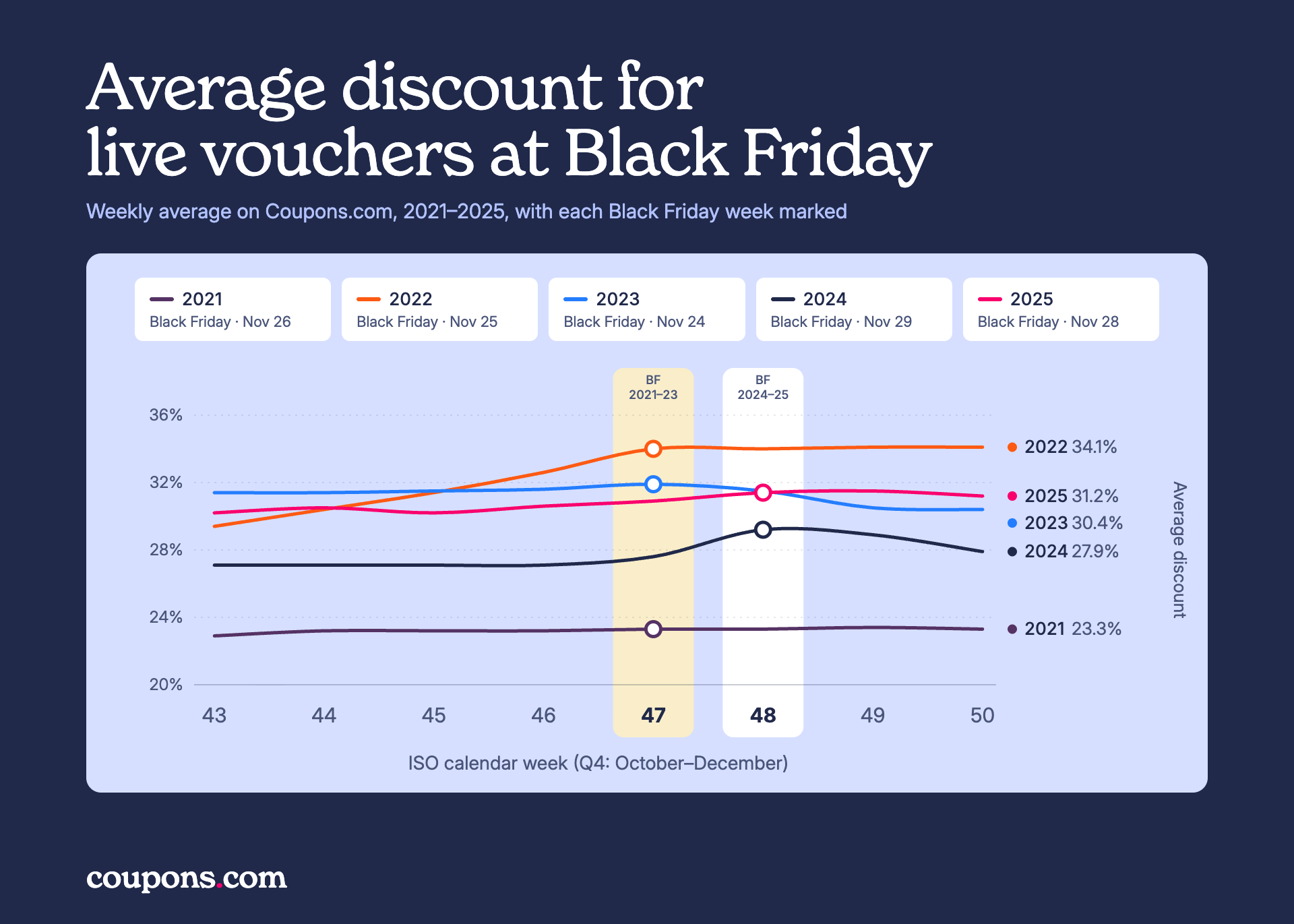
Fashion, on the other hand, had more potential to be a little different. In taking a closer look at this category, we found that after teaser deals began, discounts did get bigger at some retailers. One of those was Pandora, which in 2025 launched an early access Black Friday sale in mid-November with up to 40% off. By Black Friday, they offered up to 50% off. H&M did something similar, with sales starting at 20% off and ending at 30% off. Retailers like Pandora and H&M, however, were still in the minority.
What that means for this Black Friday is that tech shoppers can confidently pounce when they spot a good deal at the start of November, while fashion shoppers might want to keep their wishlists close and their wallets safely tucked away for a little longer.
On top of this, brands often extend their promotions through the Black Friday weekend and into Cyber Monday.
Sometimes, Cyber Monday gets extended, too. Usually, this is only by a day, but we’ve seen some retailers run their Cyber Monday deals for a whole week. Journeys and Samsung were a couple of retailers that have done this in the last few years.
When it comes to this, it’s important to note that, in our experience in the industry and working with our retailer partners, retailers aren’t guaranteed to extend their Black Friday/Cyber Monday sales period. A retailer often decides this during the sales and bases its choice on how its sales have performed that year. So we wouldn’t advise that you hold off on something you know you’ll buy to see if an extended Cyber Monday sale crops up.
Yes. Our research has shown that early Black Friday deals are often just as good as those that are running on Black Friday.
What that means is that initial sales aren’t about tricking you into buying ahead of time so that you miss out on better savings later. Instead, a majority of retailers simply throw their hat in the ring quickly in the hopes that they’ll have more people shopping. And honestly, that benefits you as a shopper since it means you can compare the deals retailers are offering throughout the month of November.
Having studied years of retailer data and our voucher history, we’ve put together our predictions for this year. From how we expect the sales season to take shape to when we anticipate some of your favorite retailers to kick off their sales, here’s what we think you can expect in 2026.
Given how Thanksgiving and Black Friday fall in relation to Halloween this year, we can expect a sales period that stretches to about four weeks. And, when we consider the patterns we’ve seen in recent years, we anticipate seeing more vouchers live earlier, too.
In other words, we expect to see the number of Black Friday vouchers that are available to ramp up one to two weeks before Black Friday. So, it won’t just feel like there are more offers available for longer; there will be more offers for you to use for a longer period of time compared to past years.
Over the last five years, 34% of retailers have pulled the trigger on Black Friday deals in late October and early November. So, we expect to see a large number of retailers kicking off sales between October 29th and November 7th, 2026.
This is a curated list of the retailers we anticipate being among the first to start Black Friday sales this year:
Anker, usually they have a 24-72 hour-only Black Friday sneak peek sale at the beginning of November
The Children’s Place
H&M
Home Depot
Jackery
Kay Jewelers
Levi’s, members only
LG
SHEIN
Samsung
Target
Wayfair
Historically, mid-November is when around 40% of retailers enter the sales period. Therefore, by the time that Black Friday week gets here, we expect to see nearly 75% of retailers participating.
Below, we’ve got a selection of retailers that we expect to launch their sales in mid-November, which is November 8th through November 21st.
Belk. They were one of the first retailers to start Black Friday sales in 2022 and 2023. Since then, they’ve launched its sales later.
Dell
DSW, with a potential for members to get access first
Gymshark
Hotels.com
HP
Macy’s
Pandora
Saks Fifth Avenue
Staples
Victoria’s Secret
Walmart. Over the last three years, Walmart has waited until mid-November to kick off Black Friday. Prior to that, Walmart often launched deals at the start of November. But we expect that this year, they’ll maintain a mid-November pattern.
As you might expect, by the week of Black Friday, there are fewer retailers joining the party. Our research found that only 21% of retailers kick off sales on the week of Black Friday. Fewer still (5%) are the retailers that kick off sales on Black Friday.
While these retailers are likely to keep you waiting, their deals could be worth it! If these are some of your go-to brands and stores, we expect them to be among the retailers launching sales between November 22nd and November 27th (Black Friday):
Bergdorf Goodman
Carhartt
Men’s Wearhouse
Rack Room Shoes
Spanx
Under Armour
Overall, it’s safe to say that Black Friday sales do not start on Black Friday anymore.
And while we can’t say that we’re surprised to see so many retailers starting their sales before the week of the big day, we were surprised to find that it’s about two-thirds of retailers who start that early. We also found it interesting to see that the number of Black Friday vouchers ramped up faster, year on year.
These pre-Black Friday savings set the stage for the core Black Friday period. And they’re why we often associate Black Friday with the majority of November. So, no, you probably won’t need to be refreshing your page at midnight on 11/26, and you don’t have to head out to get in line right after you’ve finished Thanksgiving dinner.
Instead, you can shop with confidence knowing that early deals are typically worth your while.
*Note: All percentages are rounded to the nearest whole number for ease of reading. Also, of the retailers we analyzed, about 22%* of them were what we defined as “undetermined” when it came to early Black Friday savings. This meant that we, for whatever reason, weren’t able to faithfully assess how they approached the Black Friday sales period over the last five years. We therefore removed them from further analysis since they didn’t add insight to our study. The following data refers to the 58 retailers that we could confidently review.
The Clip is where the people behind Coupons.com get to speak plainly. No press releases. No corporate polish. Just honest stories from people who think hard every day about helping you spend less and keep more.
Jump to

Parvin joined the Coupons.com team in October 2023, bringing a background in journalism and a sharp eye for detail. He started as an editor for our India market and has quickly become a valuable member of the U.S. team.
Coming from the fast-paced world of news writing, Parvin is great at spotting even the smallest details and making sure every piece of content is thoroughly researched before it goes live.
Outside of work, you’ll usually find him deep in a mystery novel or training for his next marathon.
As an editor, Parvin enjoys helping readers shop smarter by sharing practical, money-saving tips. He’s committed to creating high-quality content that helps people stretch their budgets and get more value from the products they love.