Can AI tools find you good discounts? Most of the time, the answer is no.
Can AI tools find working coupon codes? We decided to put ChatGPT, Gemini, and Claude to the test to find out. Spoiler alert: They didn’t do well, and here’s why.

Since the rise of LLMs, it has been suggested that coupon sites are at risk of being skipped by users, since LLMs are now, in theory, able to provide a user with working coupon codes to use during their shopping journeys.
Being a coupon site ourselves, we decided to validate the hypothesis statistically, qualitatively, and above all, through a trusted and transparent methodology.
The set-up
In our test, we took 101 well-known US retailers (your favorite stores according to years of our data), and we fed ChatGPT, Gemini, and Claude the following prompt: “Find me valid, currently working coupon codes for [retailer name]. List each code with the discount it gives.”
We recorded each response and parsed the coupon codes that were returned. Then, we tested each of the codes manually at the stores themselves to see if it worked.
The findings: Less than 1 in 4 coupon codes work
Let’s start with the overall findings. The table below shows the results per tool. Overall, of the codes we were successfully able to test, only 24.5% returned as working, with the remaining 75.5% not working*.
That’s compared to an 89% success rate for coupons sourced directly from Coupons.com for the same retailers that our team tested over the course of a few days**. (Side note: The reason it wasn't 100% every time we tested is due to factors that are out of our control, such as retailers ending promotions early, codes with limits on the number of uses, etc.).
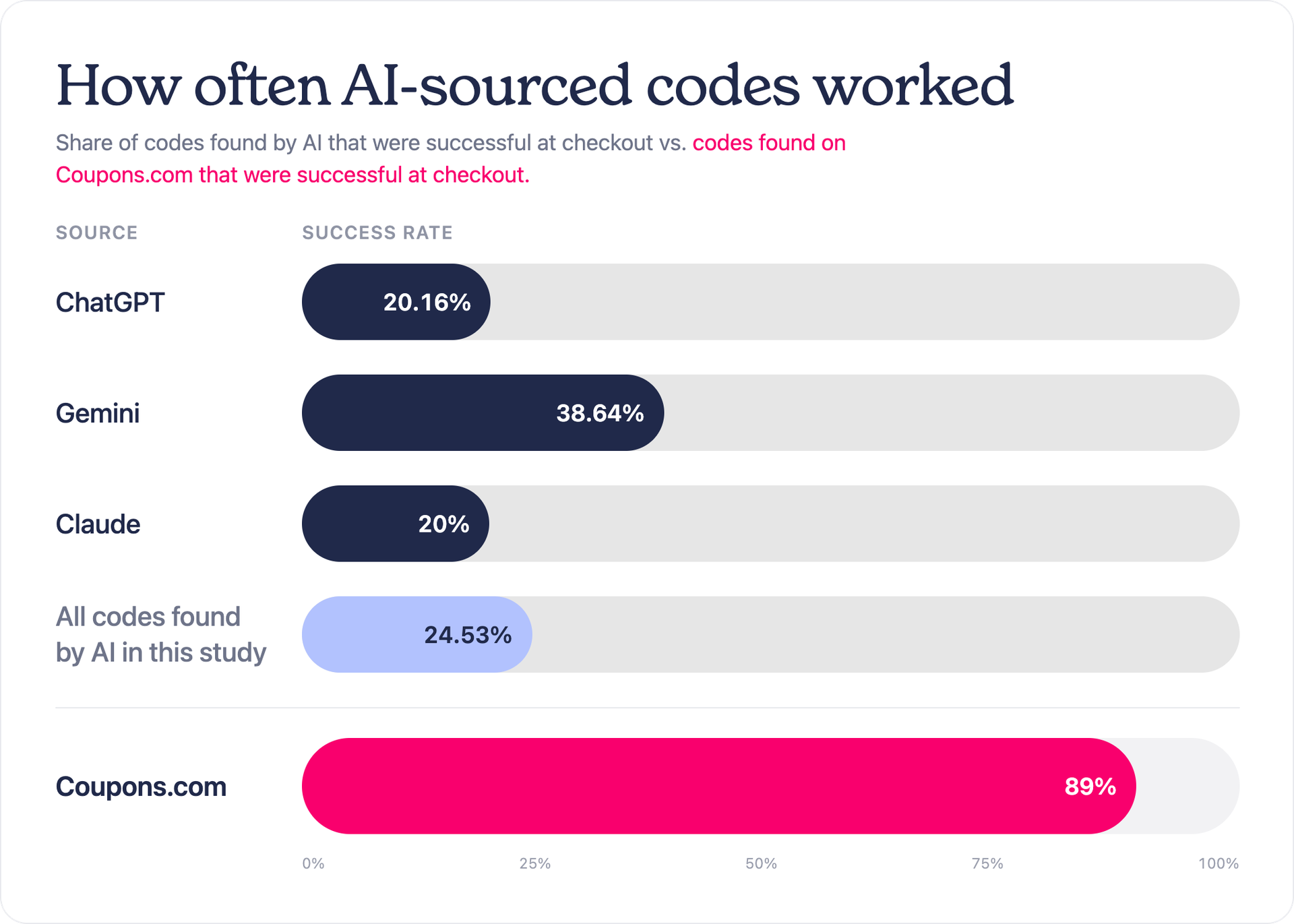
In summary, Gemini had the best success rate of the three AI tools, with 38.64% of the codes it suggested working. Interestingly, in terms of how many codes it shared, it was bang in the middle, suggesting 155 codes from 101 prompts.
ChatGPT, however, was the most prolific tool for coupons, returning a total of 476 codes.
Claude was by far the most cautious, suggesting just 58 codes across 101 retailers. Claude often chose not to share any codes. That, in a way, makes it even more interesting that it had the lowest working code rate of all three tools.
So, while ChatGPT confidently suggested codes, Claude usually decided not to. Yet the outcome for these two AI tools was almost exactly the same in terms of working codes.
The table below has some more detail on how the different tools responded to our prompt for coupons:
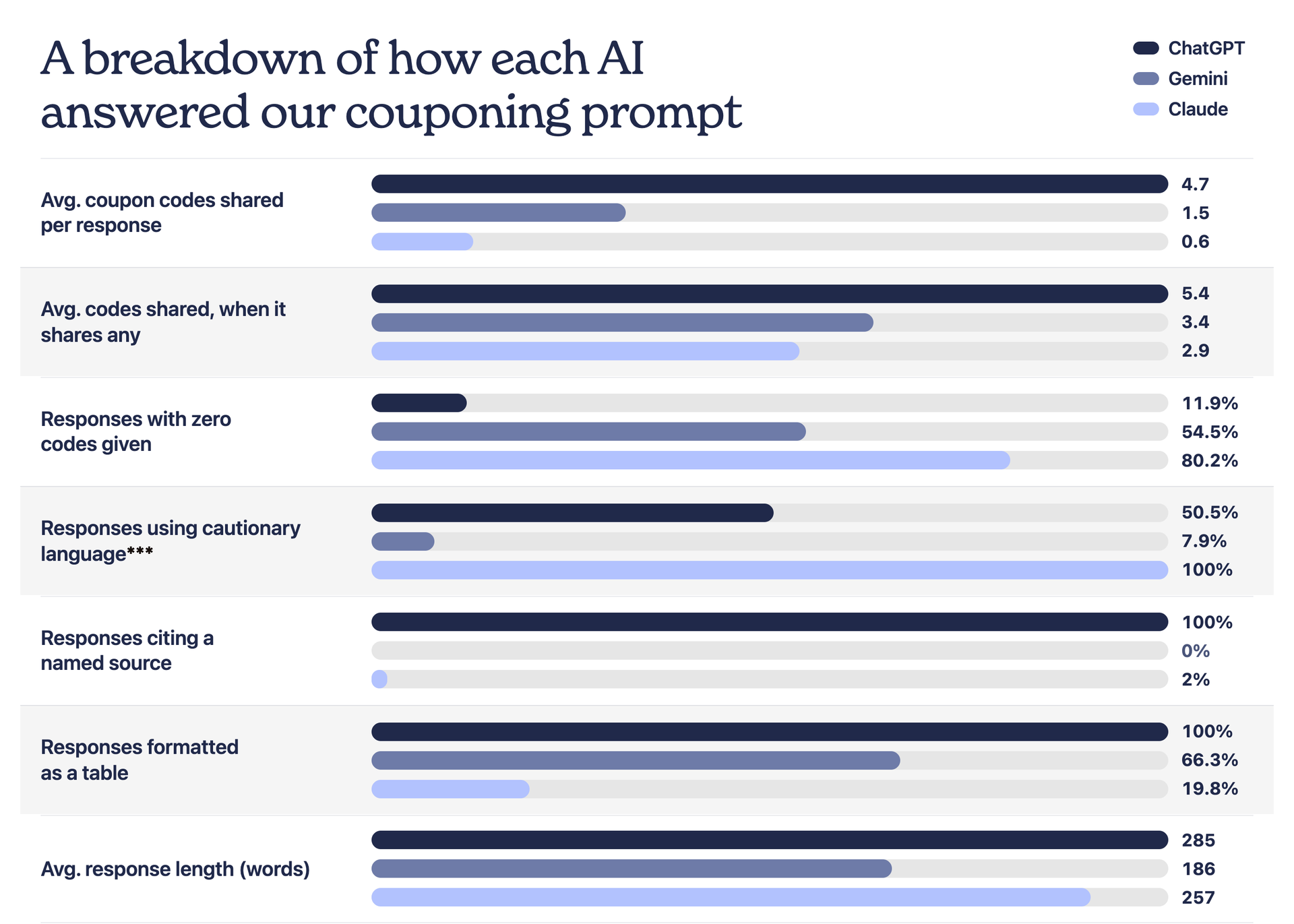
Here, one metric is particularly notable: ChatGPT cited sources in every case, while Gemini and Claude almost always didn’t. The sources ChatGPT cited also reveal why the results it returned were so bad. Let’s explore this topic.
The problem with ChatGPT’s sources
We’re talking about ChatGPT specifically, simply because ChatGPT was the only tool that explicitly named its sources. The conclusion, however, probably applies to all AI tools, as they tend to do a similar thing behind the scenes.
When you ask an AI chat tool to find you coupons, it begins searching the web. It then attempts to read and extract the coupon codes from the pages it visits. When it manages to find a code, it responds to your query with the code and, in the case of ChatGPT, the source.
It would be reasonable to assume that, given these are the websites ChatGPT has chosen to cite, it must have determined them to be amongst the most reliable sources for working coupon codes. But if so, why do only 20% of the codes it returns work?
There are two possible (and likely) explanations:
Coupon sites, in general, are unreliable and publish a lot of non-working codes.
ChatGPT did a bad job of choosing its sources and couldn’t reliably scrape results from more reliable sources.
1. Explanation 1: Unreliable, non-working codes published by sites
Sites like ours are many, but sites doing the legwork to test, verify, and curate working codes as we do are few and far between. For LLMs, this wreaks havoc on the reliability of their output.
What we mean by this is that there are hundreds of websites that offer coupon codes in the US. However, a large majority of them don’t adhere to editorial standards and quality control practices.
Trusted sites like ours that maintain and grow relationships with brands and shoppers can be counted on just two hands. We and those like us are subject to commercial requirements, rules, and parameters given to us by the brands we work with. We then test and verify every code and coupon before we publish them for our users.
Unfortunately, the majority of aggregator pages don’t do this and instead publish an overwhelming number of coupons that are not tested, likely don’t work, and ultimately fail shoppers whether they get directly from a website or via AI.
2. Explanation 2: Bad sourcing leading to poor search results
In order for an LLM to extract a coupon code from a website, it must be able to read the site. So, when we asked AI to “find me valid, currently working coupon codes”, the AI model then went through all the text, code, and images on sites it has access to to fulfill our request.
Simple, right? Sure. However, there’s more to this, and it explains why AI readily relies on bad sources.
Reputable sites that put a lot of hard work into making their product great don’t allow LLMs to read all of their site, and therefore LLMs aren’t able to scrape information from them. We are among the sites that don’t allow AI to read everything on its pages.
If that sounds harsh, here’s why we, and other sites like ours, do this.
We invest in real people who do all of the behind-the-scenes work so that we know our content works for you. Our teams adhere to the requirements of brands, ensure that our shoppers have the best experience and actually save money, and find the best codes available at any given moment.
To continue to invest in our people, which in turn allows us to bring you meaningful savings, we need users to bring traffic to our pages and help us generate revenue. If AI is allowed to scrape all the information we’ve worked hard to find, the opportunity for us to make money is bypassed.
Now, that may not sound like a huge deal, but if that happens on a large scale, our business model is no longer sustainable, and we’re then unable to create high-quality content that actually works to save you money.
Besides the fact that we don’t think it’s fair for AI to steal our coupon codes, we simply can’t afford to let it happen. And the few reputable couponing sites that we mentioned earlier? They’re doing the same thing as us. And this shows up in the citations provided by ChatGPT in our test.
You can see this for yourself by looking at what websites ChatGPT cites when it gives you a code to use, and more importantly, what websites it doesn’t cite.
For example, Coupons.com was never mentioned as a direct source for a specific coupon code during our test; it only appeared in general advice about where to look for working coupons.
We can see why when we ask ChatGPT directly to only use us as a source:
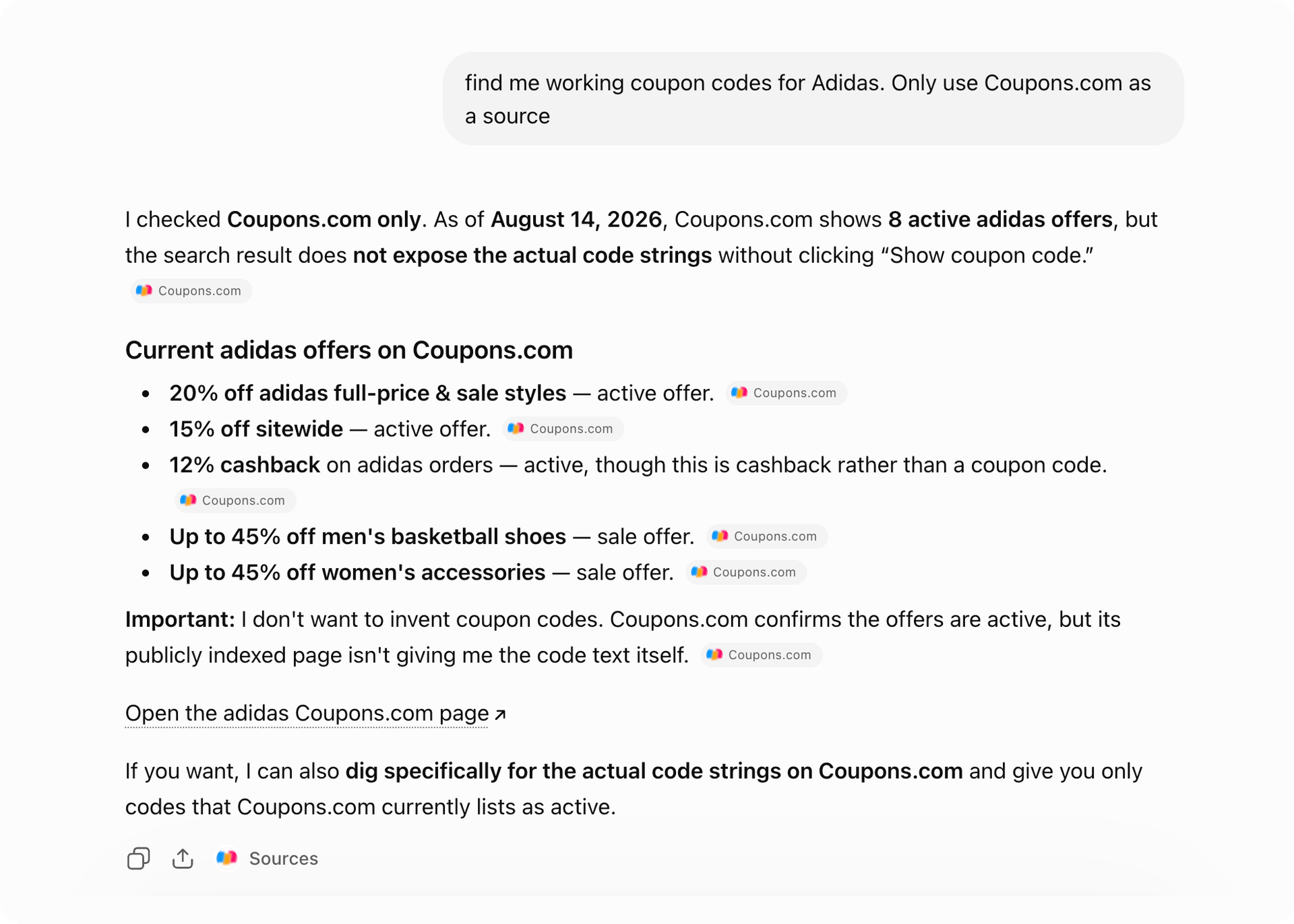
As you can see, we never show up as a cited source for specific coupon codes returned by ChatGPT in our test because we’ve designed our site to be this way. We allow LLMs to see and read what we want them to. So, an AI is able to bring you details about the discounts we have to offer, our expert advice on how to save at retailers, and money-saving tips we have, but AI can’t scrape actual codes from us.
By doing this, we can continue to invest in our team to provide hand-checked codes ourselves.
Ultimately, though, the majority of aggregator sites aren’t doing this. Those that publish anything and everything without being selective put a lot of non-working codes out there. They let AI scrape their pages, and then shoppers who ask AI to find them a working code get stuck with bad info.
This is proven by our test, and it’s why, at best, AI was only able to return working codes 38% of the time compared to the 89% success rate of the codes found directly on our site.
Conclusion: AI can’t replace humans when it comes to coupons
At least, not yet. Our test revealed that AI can only be as good as its resources, and LLMs aren’t able to discern what makes a source good.
The more interesting result of our study is that it means that people still do a better job of bringing you reliable, working coupon codes. That’s because real people are able to take everything into consideration, test them firsthand, and vouch for their success.
So, the message to people who want to save money online using AI is this: Use AI for your research and learning about the products, use AI for evaluation and the decision-making of what you want to buy, but don’t use it to find the best working coupons.
Instead, continue using reliable sites with real humans behind them. A good way to identify these trusted sites is to evaluate whether they are transparent about how they source their codes, their relationships with the brands, and the degree of verification that their codes have.
Reputable sites want their shoppers to feel confident at every point of their shopping experience. And to continue doing this, they have to limit how AI can interact with their site so that they can keep the lights on and so that you can keep saving money.
*46% of the total codes returned couldn’t be reliably tested as they had specific conditions attached to them that were either not mentioned or unable to be replicated. Such codes are excluded from the results here.
**All data used in our study was gathered by our team between August 4, 2026 and August 7, 2026.
***Cautionary language = phrases like “can’t guarantee”, “can’t verify”, “unreliable”, “reported working”, etc.
The Clip is where the people behind Coupons.com get to speak plainly. No press releases. No corporate polish. Just honest stories from people who think hard every day about helping you spend less and keep more.

Ben has spent the past four and a half years with the Atolls team working in different marketing roles. Originally from the UK, Ben is now based at the company's Munich headquarters, where his work spans all 21 of Atolls' markets. This includes spotting the deals, trends, and data that matter to Coupons.com readers and shoppers.
Outside of work, Ben brings the same eye for a bargain to his own life. He especially enjoys finding "creative" ways to save money on travel; once, this meant taking an eight-hour bus journey just to save $100 on a flight. He also gets a genuine thrill from stacking coupons and cashback to maximize savings when buying online.